India’s startup ecosystem is entering a reality check.
The focus has shifted from unchecked growth to profitability and efficiency. In this phase, AI is no longer optional. It has become a core operational necessity.
Startups are using AI to automate manual work, reduce costs, and simplify operations. This shift is already visible through internal restructuring, leaner teams, and AI-driven workflows. The message is clear: AI now delivers direct ROI.
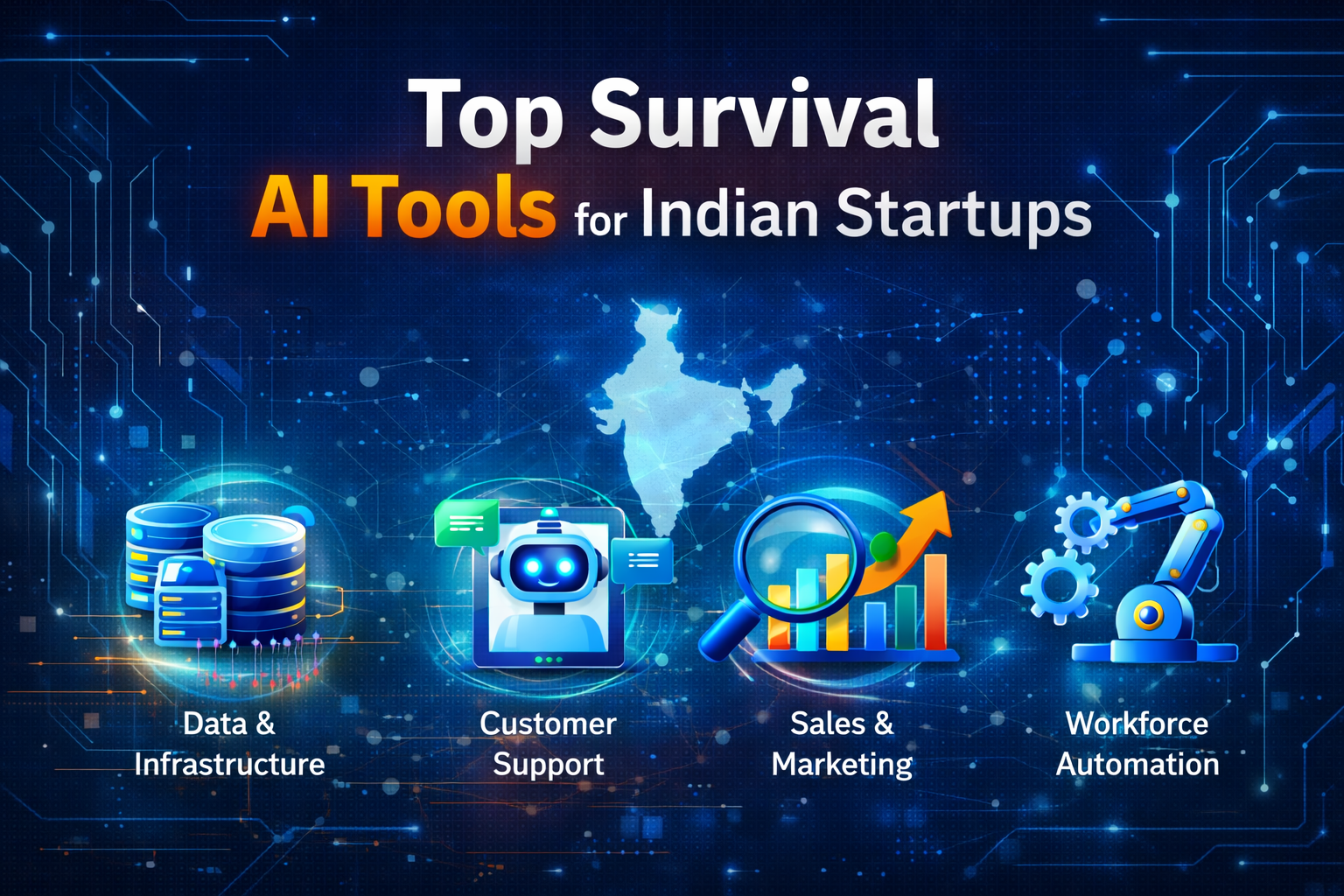
Below is a clean, practical breakdown of the AI tools Indian startups are actively using, grouped by business function and focused on automation and impact.
AI Tools for Founders & CTOs (Operational ROI and Infrastructure)
Founders and CTOs are investing in foundational AI platforms. These tools act as an AI Nervous System, preparing the entire tech stack for scale and profitability.
SCIKIQ Data – AI Readiness Layer
SCIKIQ Data solves one of the biggest AI problems: fragmented data.
It unifies enterprise data and adds business context.
Teams can launch AI and ML initiatives 4x faster than with legacy systems.
The biggest benefit is reliability.
Data becomes production-ready, not experimental.
This directly reduces AI failure rates.
MonkDB – AI-Native Unified Database
MonkDB is built for AI-first systems.
It combines structured data, unstructured data, vectors, and time-series data in one place.
All data can be queried using a single SQL interface.
This removes the need for multiple databases.
Decision-making becomes faster and real-time.
Infrastructure complexity drops sharply.
CodeAnt AI – Code Health and Engineering Efficiency
CodeAnt AI replaces multiple engineering tools with one AI platform.
It automates code reviews, finds security issues, and generates AI-based fixes.
It has reviewed 4+ million pull requests and saved 500,000+ developer hours.
Companies like Akasa Air and Bajaj Finserv use it in production.
Engineering teams ship faster with fewer bugs.
Clear (Fintech) – AI-Driven Cost Control
Clear laid off 145 employees in August 2025 during a stated AI-led efficiency push.
This move sent a strong signal.
Even mature startups are using AI to reduce costs and control losses.
AI adoption is no longer experimental.
It is structural.
AI Tools for Customer Support & Conversational Engagement
Customer support is often the first function startups automate.
The ROI is immediate.
Headcount dependency drops quickly.
Gupshup – Large-Scale Conversational Automation
Gupshup is a clear example of AI-led restructuring.
It laid off 500 employees in April 2025.
Another 100 roles were cut in September 2025.
Startups use Gupshup to automate massive volumes of customer conversations.
Support costs fall while scale increases.
TensorGo (HumAIn) – AI Digital Teammates
TensorGo introduces Humanized AI Digital Teammates.
These AI agents join Zoom, Google Meet, and Teams.
They read behavior, transcribe discussions, and deliver insights.
Teams make decisions 40% faster.
Meetings become outcome-driven instead of note-driven.
LiaPlus AI – Speech-Based Support Automation
LiaPlus AI focuses on voice-based customer support.
It uses AI-powered speech recognition and synthesis.
Startups deploy it for consistent, scalable interactions.
This reduces call center load and improves response quality.
AI Tools for Sales Automation & Marketing
Sales and marketing AI removes manual research and content bottlenecks.
The focus is speed, cost reduction, and lead efficiency.
SPYNE (Studio AI) – Visual Content Automation
SPYNE converts simple product photos into professional visuals.
It generates catalog images and 360-degree spins using AI.
Dealerships using SPYNE report:
- Up to 70% more leads
- 80% lower content costs
- 60% faster go-to-market
Visual production becomes scalable and affordable.
AI Palette – FMCG and CPG Market Intelligence
AI Palette replaces traditional market research.
It analyzes 61 billion data points across multiple languages.
Trends, concepts, and product ideas are generated in a single day.
Brands like Nestlé and Coca-Cola use it to move faster than competitors.
Research cycles shrink from months to hours.
Acta.ai – Sales Workflow Automation
Acta.ai uses persona-based AI agents for sales teams.
It converts messy meetings into structured outputs.
Follow-ups and documentation are automated.
Sales teams spend less time on admin work.
More time goes into closing deals.
CreditNirvana (Perfios Acquisition) – Collections Automation
Perfios acquired CreditNirvana mainly for its AI capability.
The platform automates debt collection workflows.
Manual calling and follow-ups are reduced.
Collection costs fall without hurting recovery rates.
AI Tools for Hiring & HR Automation
HR teams are using AI to manage repetitive, high-volume work.
The goal is control, not expansion.
Acta.ai – HR Agent Workflows
Acta.ai also deploys HR-specific AI agents.
They convert internal discussions into compliance-ready documentation.
Tracking and reporting become automatic.
HR overhead reduces significantly.
Mowito Automation – Industrial Workforce Automation
Mowito uses AI to give robot arms human-like perception.
Factories automate complex tasks without hardcoding.
Assembly and inspection become flexible.
This directly reduces reliance on manual labor.
BetterPlace – Workforce Management Infrastructure
BetterPlace supports startups with large gig workforces.
It handles screening, onboarding, and operations.
High churn becomes manageable.
Labor costs stay under control.
Indian startups are no longer using AI for demos or branding.
They are using it to:
- Cut costs
- Automate teams
- Reduce hiring dependency
- Improve execution speed
These are not influencer tools.
These are survival tools for startups operating in a profitability-first era.
AI is no longer about the future.
It is about staying alive today.


